
Ruby Receptionists review: pricing per minute, and when AI is enough
Ruby puts a live US receptionist on every call, 24/7, from $250 a month for 50 minutes. What it costs at 200 calls a month and when an AI receptionist fits better.
Ruby (Ruby Receptionists) is a human answering service. Live receptionists answer every call in your business’s name, 24/7, including nights, weekends and holidays. Ruby uses AI, but only behind the scenes: an assistant called Call Nav that its receptionists consult, plus transcripts, sentiment analysis and robocall filtering. No AI answers your callers, and you can opt out of the AI features entirely (AI at Ruby).
Ruby is one of the best-known names in the category, and the benchmark most owners hold an AI receptionist up against. So this review focuses on the decision you are probably making: is a real person on every call worth Ruby’s price, or would an AI receptionist do?
What callers hear
A receptionist answers with your greeting, then transfers the call, takes a message, schedules an appointment, qualifies a lead or takes a payment, following instructions you give Ruby. They can also make outbound calls for you. English and Spanish answering and HIPAA service with a signed BAA are included at no extra cost (FAQs). You see messages and manage everything in Ruby’s online portal and its iOS and Android apps.
The value is in the hard calls. A person can calm a frightened client, notice that a “quick question” is really an emergency, and handle a caller who refuses to follow a script.
What it costs at real call volumes
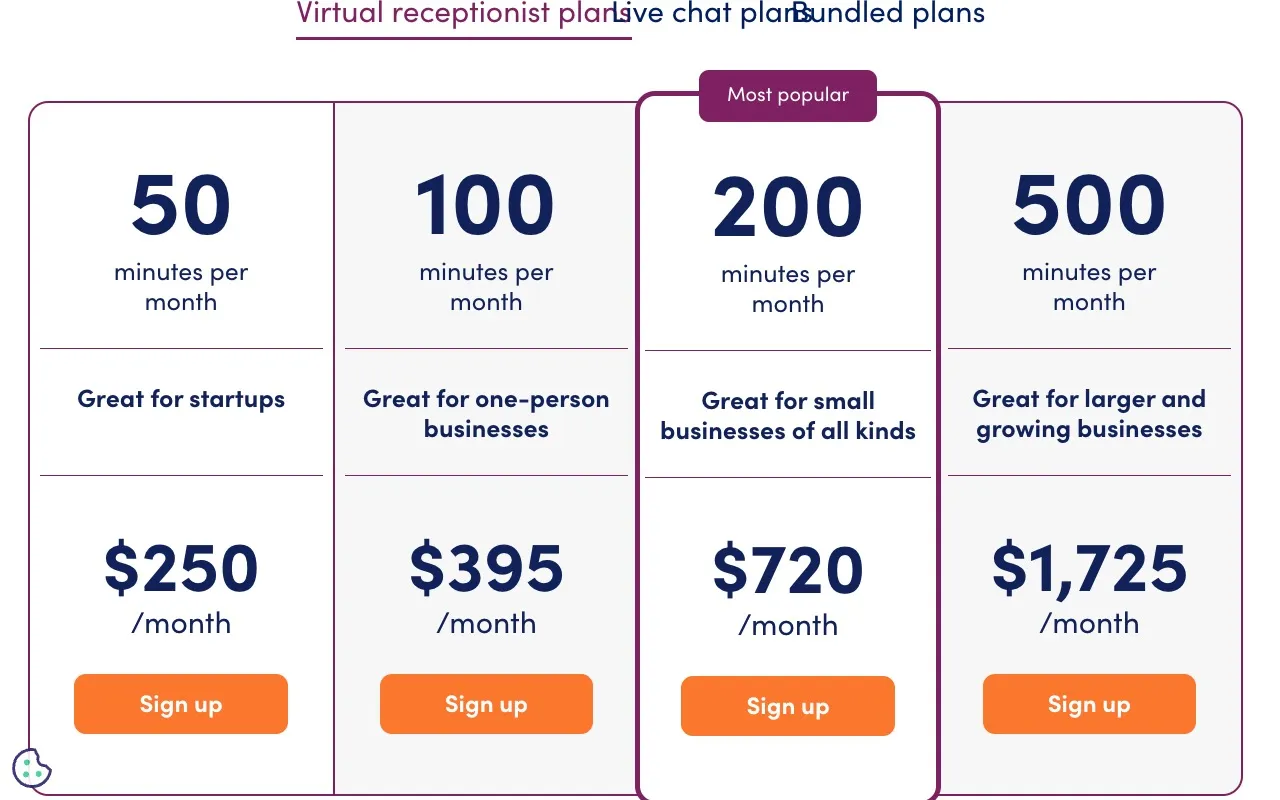
Ruby publishes four plans: $250 a month for 50 minutes, $395 for 100, $720 for 200 and $1,725 for 500 (plans and pricing). That works out to about $5.00 a minute on the smallest plan and about $3.45 on the largest. There is no setup fee and no long-term contract.
Three billing rules matter as much as the price:
- Rounding. Minutes are billed in 60-second increments, rounded up. A 20-second call costs a full minute.
- Hold time and after-call work count. The time a receptionist spends on hold for you or writing up a message is billed. Transferred talk time is not (FAQs).
- Overage isn’t published. Extra minutes are billed at “the overage rate associated with your plan”, which Ruby doesn’t list.
Work it through for a business with 200 calls a month at about 3 minutes each. That’s 600 minutes before rounding and after-call work. The 500-minute plan at $1,725 doesn’t quite cover it, so you’d pay $1,725 plus overage on at least 100 minutes at a rate Ruby doesn’t publish. That’s more than $8.60 a call before any extras.
A smaller office with 50 calls a month at 3 minutes needs about 150 minutes plus extras. The 200-minute plan at $720 is the safe choice there, about $14.40 a call.
Compare that with AI receptionists. Sameday AI covers 1,000 AI minutes for $789 a month, and for restaurants, Loman’s blog says its plans start at $199 a month with unlimited calls (Loman blog). Our AI receptionist pricing guide lays out the models side by side.
Trial, contracts and setup
Ruby has no free trial. Instead, new customers get a 21-day money-back guarantee, which ends sooner once usage passes 500 receptionist minutes (get started). Plans are month to month. You can use a Ruby number or keep your own.
Calendars and software
Receptionists can book into Calendly and Google Calendar. Ruby’s integration list leans toward law firms (Clio, MyCase, Filevine, Rocket Matter, Law Ruler, Lawmatics), with HubSpot, Salesforce, Keap, Zoho, Slack, Microsoft Teams and Zapier for everything else (integrations). Home-service owners will find JobNimbus and FieldPulse, but the list doesn’t name ServiceTitan, Housecall Pro or Jobber.
One HIPAA catch: under HIPAA service, messages aren’t emailed or texted and Calendly can’t be used, so a medical office loses some of the convenience that makes Ruby easy for everyone else.
When an AI receptionist fits better
Ruby is hard to justify when most of your calls are routine. If callers mostly want your hours, a quote range or an appointment, an AI receptionist will answer them instantly, book directly into your calendar or field-service software, and handle several calls at once, for a small share of Ruby’s bill.
An AI receptionist also fits better if your volume is high. Ruby’s price climbs in a straight line with your minutes; at a few hundred calls a month, the gap becomes thousands of dollars a year.
Ruby fits better if:
- your callers are often stressed or the conversation is sensitive (legal intake, healthcare, crisis calls);
- a mishandled call costs you a client worth far more than a month of Ruby;
- you need payments taken or leads qualified by someone who can use judgment.
If you want both, Abby Connect puts an AI receptionist and live receptionists on one plan. Its human minutes cost about $2.76 to $3.29, less than Ruby’s, and its AI minutes cost half that. For the full picture, see AI receptionist vs answering service.
How Ruby compares
vs AnswerConnect. Also human-only, by an explicit pledge. Its published plans work out to about $1.32 to $1.75 per included minute, far below Ruby, though its main pricing link asks for your contact details first and some plans carry a $49.99 setup fee.
vs Abby Connect. US-based receptionists like Ruby, cheaper per human minute, a free trial, and an AI option for routine calls.
vs Smith.ai. Smith.ai offers live North America-based receptionists billed per call rather than per minute, from $300 a month for 30 calls, plus an AI receptionist from $150 for 75 calls that can hand callers to its live agents. Unlike Ruby, it says it isn’t HIPAA-compliant. See Smith.ai vs Ruby.
The Ruby alternatives page ranks the options in more detail.
Verdict
Ruby is a polished, predictable human service: published prices, no setup fee, no contract, Spanish and HIPAA included, and a money-back guarantee instead of a trial. It is also one of the most expensive ways to get your phone answered, at $3.45 to $5.00 a minute before rounding, hold time and after-call work. Pay for it when every caller truly needs a person. If they don’t, start with the best AI answering services and keep Ruby in mind for the calls that matter most.
Pricing
| Plan | Price | Included | Extra use | Details |
|---|---|---|---|---|
| 50 minutes | $250/mo | 50 min | – |
|
| 100 minutes | $395/mo | 100 min | – |
|
| 200 minutes | $720/mo | 200 min | – |
|
| 500 minutes | $1,725/mo | 500 min | – |
|
Strengths
- A live person answers every call 24/7, including nights, weekends and holidays, with no extra charge for after-hours coverage
- Simple published pricing: four minute plans, no setup fee and no long-term contract
- Spanish bilingual answering and HIPAA service with a signed BAA at no extra cost
- Receptionists can schedule appointments, take payments, qualify leads and make outbound calls
- Native Clio and Grasshopper integrations plus Zapier, and a 21-day money-back guarantee for new customers
Weaknesses
- Expensive per minute: $250 a month buys 50 minutes, about $5 a minute, and even the 500-minute plan works out near $3.45
- Overage rates aren't published, and hold time and after-call work count toward your minutes
- No AI receptionist to answer calls on its own; AI only assists the human receptionists
- Minutes are rounded up to the next full minute, so short calls cost more than they last
Best for
Sources
- Ruby plans and pricingChecked Nov 8, 2026
- Ruby: AI at Ruby (Call Nav, transcripts, sentiment analysis, robocall filtering)Checked Nov 8, 2026
- Ruby FAQs (billing increments, overage, contracts, HIPAA, bilingual, numbers)Checked Nov 8, 2026
- Ruby: Get started (21-day money-back guarantee)Checked Nov 8, 2026
- Ruby integrationsChecked Nov 8, 2026