
Loman AI review: an AI phone agent that takes restaurant orders
Loman answers restaurant calls, takes orders and card payments into Toast, Square or Clover, and books tables. What the pricing and contract terms really mean.
Loman is an AI phone agent for restaurants, and its focus is phone orders. It reads your menu, takes takeout and delivery orders with modifiers (“no onions, extra sauce”), collects card payment on the call, suggests add-ons, and sends the ticket to your POS (Loman homepage). It also answers common questions and books tables in OpenTable or Resy.
If your phone rings off the hook between 5 and 8 and someone on the line is stuck taking orders instead of cooking or serving, that is the problem Loman is built for.
Who it’s for
Loman fits pizza places, takeout and quick-service restaurants that take a lot of orders by phone, especially those on Toast, Square or Clover. It integrates with those three plus SpotOn, Shift4 (SkyTab), Aloha, Olo and Stream.
A full-service restaurant that mostly takes reservations by phone may be better served by Slang AI, which is built around OpenTable, SevenRooms and Resy bookings rather than orders. And Loman is restaurant only: it isn’t a general receptionist for a salon or a law office.
What callers hear
The AI answers around the clock and can handle many calls at once, so callers don’t hit a busy signal at peak. Loman’s Starter plan lists up to 50 simultaneous calls. It recognizes repeat callers, and its menu stays in sync with your system, so when the last brisket sells out, the AI stops offering it mid-service.
Loman says it answers in 55 languages, detecting the caller’s language and sending the ticket to the kitchen in English (multilingual answering). For a restaurant in a neighborhood with many Spanish, Chinese or Arabic speakers, that’s useful.
When it can’t help, it transfers to a live line, takes a transcribed voicemail, or messages your team. A dashboard shows live calls, transcripts, recordings, orders and outcomes.
What it costs
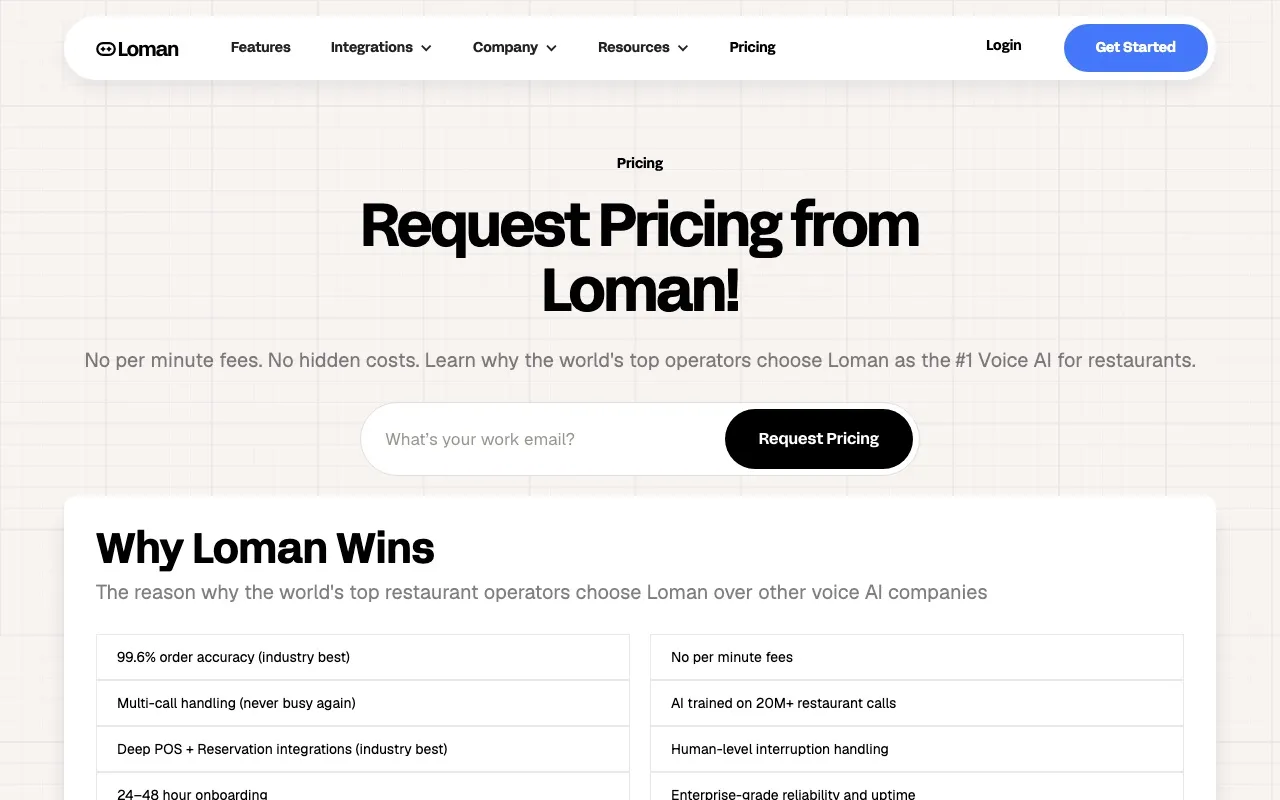
Loman’s pricing page lists three plans, Starter, Premium and Enterprise, and asks you to request a quote for each (pricing). Its own blog is more forthcoming: plans start at $199 a month with unlimited calls and no per-minute fees (Loman vs Slang AI).
Read those two together carefully. The blog says the $199 price includes order taking, payments on the call and POS integration. The plan list puts full POS ordering and payments in Premium, not Starter, which answers questions, transfers calls, texts callers and keeps the menu updated. If what you want is orders landing in Toast, get in writing which plan $199 buys and what Premium costs.
Loman’s terms add more detail: each location has its own monthly fee, and the talk-time minutes and any setup fee are set on your order form (terms). Ask how that squares with “unlimited calls” before you sign.
Here’s what a flat fee means in practice. Say you take 200 calls a month at about 3 minutes each. At $199, that’s about $1 a call. At 600 calls, around 33 cents. Busy restaurants come out well on flat pricing, compared with per-minute plans where each order costs more the longer the caller deliberates over toppings. Our AI receptionist pricing guide explains the trade-off between flat and per-minute pricing.
Contracts
This is the part to read twice. You choose a 1, 3, 6 or 12 month initial term, after which the service renews month to month. Leaving early makes the rest of the term due, and fees are non-refundable (terms). There’s no free trial on Loman’s site, only a demo call.
If you’re unsure, pick the one-month term. A month is enough to see whether your regulars will order from an AI.
Setup
Onboarding takes 24 to 48 hours, Loman says. You keep your existing number and forward it to Loman, so nothing changes on your website, Google listing or menus. The work on your side is checking the menu the AI will read, especially modifiers and combo rules, and deciding which calls should always go to a person (catering orders or complaints, for example).
How it compares
vs Slang AI. Slang is built for reservations and full-service dining, publishes starting prices of $399 and $599 per location, and lists no POS integration. Loman is built for orders and payments into the POS, and its blog’s starting price is lower. Pick by what most of your calls are: tables or takeout.
vs a general AI receptionist. Taking a message or booking a calendar slot is not the same as taking an order with modifiers into your POS. For a restaurant that takes orders by phone, check for menu and POS support before anything else.
See more options in the best AI receptionists for restaurants.
Verdict
Loman is one of the few AI phone agents that can take a real restaurant order end to end: menu, modifiers, payment and ticket in the POS. Flat pricing suits busy phones, setup is quick, and you keep your number. The catches are opacity and commitment. The pricing page has no prices, it’s unclear whether the $199 starting price includes ordering, and early cancellation leaves the rest of your term due. Get a quote for Premium at your location count, confirm what “unlimited” means on your order form, and start with the shortest term.
Pricing
| Plan | Price | Included | Extra use | Details |
|---|---|---|---|---|
| Starter | Custom | – | – |
|
| Premium | Custom | – | – |
|
| Enterprise | Custom | – | – |
|
Strengths
- Takes full phone orders with modifiers and payment, straight into Toast, Square, Clover and other POS systems
- Flat monthly fee per location with no per-minute charges; its blog puts the start at $199 a month
- Answers many calls at once, so the line is never busy at peak
- Syncs the menu in real time, so sold-out items and price changes apply mid-call
- Answers in 55 languages, detecting the caller's language and sending tickets in English
- Live in 24 to 48 hours, keeping your existing number by forwarding
Weaknesses
- Its pricing page has no prices: you request a quote and book a demo
- Priced per location on a 1 to 12 month initial term; leaving early makes the rest of the term due, and fees are non-refundable
- No free trial on its site, only a demo call
- Restaurants only
Best for
Sources
- Loman homepageChecked Nov 8, 2026
- Loman pricing (plans, request pricing)Checked Nov 8, 2026
- Loman blog: Loman vs. Slang AI (states the $199 a month starting price), Aug 18, 2026Checked Nov 8, 2026
- Loman terms and conditions (fees, initial term, auto-renewal, call recordings)Checked Nov 8, 2026
- Loman: Multilingual phone answering (55 languages)Checked Nov 8, 2026