
Simple Phones review: cheap AI call answering, with one big catch
Simple Phones answers missed calls from $49 a month for 100 calls, with a 14-day trial and no contract. What 200 calls cost, and what happens if you go over.
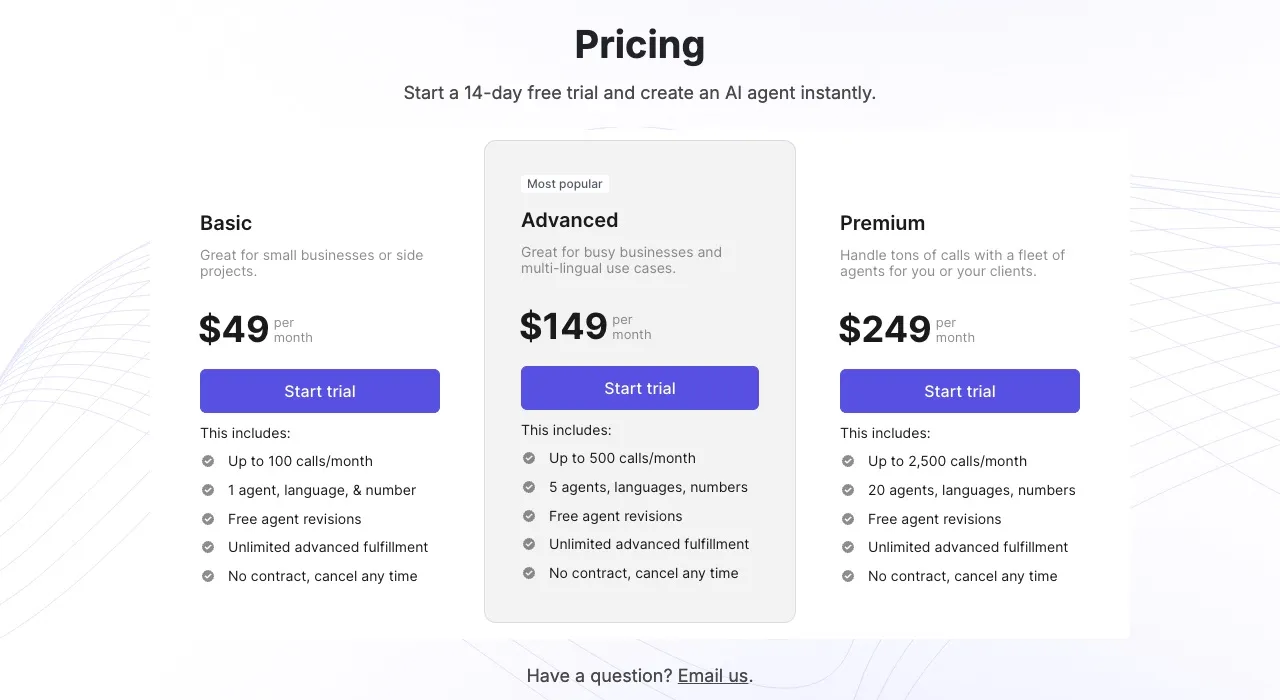
Simple Phones is a self-serve AI phone agent for small businesses. You answer a few questions at signup, it generates a starter agent that answers questions, books appointments and takes messages, and you forward your missed calls (or all calls) to the number it gives you (Simple Phones). Its pricing is among the lowest we’ve seen: $49 a month for up to 100 calls, with no contract and a 14-day free trial.
The low price comes with trade-offs worth understanding before you forward your business line to it.
Who it’s for
Simple Phones suits a small business that mostly needs missed calls answered and messages taken: a handyman, a cleaning company, a small shop. If the main problem is that calls go to voicemail and callers hang up, a cheap agent that picks up, answers the basics and passes on the message solves most of it.
The higher plans include several agents, languages and numbers (5 on Advanced, 20 on Premium), which suits a business with a few locations, or an agency running agents for its clients.
It fits less well if you need appointments to land in a specific calendar or booking system. Simple Phones doesn’t name the calendar apps it books into, and says CRM connections are handled case by case by its team (FAQ). Ask exactly where bookings will land before you rely on it.
What callers hear
Callers reach an AI agent that greets them, answers questions from your website or FAQ documents, and books an appointment or takes a message. It can transfer calls to other numbers based on rules such as the time of day, and alert your team by text, email or webhook (routing). It speaks 19 languages, and phone numbers are available in 25 countries.
Each call is logged with the caller, duration and a transcript (API docs). That’s enough to call someone back with context.
One caution on quality. The help docs describe the agent as a menu of fixed flows, such as booking a call or leaving a message, with a GPT-3 fallback for everything else, and the privacy policy says agents run on Twilio and Dialogflow CX (inbound calls, privacy). The company blog hasn’t had a new post since 2024 (blog). The docs may simply be out of date, but call the sample agent on the homepage and judge for yourself how natural it sounds. That’s what your customers will hear.
What it costs at real call volumes
Simple Phones charges by the call, not the minute, so a long call costs the same as a short one. That’s good news if your calls run long.
Take 200 calls a month at about 3 minutes each:
- Basic ($49, up to 100 calls) is too small.
- Advanced ($149, up to 500 calls) covers it, at about $0.75 a call. You’d have room to more than double your volume before needing Premium.
For a business with 80 missed calls a month, Basic works out to about $0.61 a call, which is very cheap for AI answering.
Now the catch. There is no overage. If you go over your plan’s calls in a month, Simple Phones releases your phone numbers (FAQ). The agent is kept, but the number your calls forward to stops working. For a business forwarding missed calls, one busy month on Basic could leave callers reaching a dead number.
So size the plan with real headroom. If you average 80 calls, a 120-call month after a promotion or a storm puts you over. Treat Basic as safe only if you’re well under 100 calls in your busiest month, and move to Advanced early.
There’s also a pricing mismatch: the FAQ still says plans start at $97 for 100 calls, while the pricing table shows $49 (Simple Phones). Confirm the price at checkout.
Setup and contracts
Setup is quick. Signup generates a starter agent in about a minute, and your existing number stays on your business cards because you only forward calls to Simple Phones. The phone line and building the agent cost nothing extra.
The useful twist is that you don’t edit the agent yourself. You ask for changes to its wording, voice, behavior, knowledge or integrations, and the Simple Phones team makes them for free. For an owner with no time to learn a call-flow editor, that’s a real plus; the cost is waiting on someone else for each change.
There’s no contract, and you can change plans or cancel any time. The 14-day trial is long enough to run it on real missed calls and read the transcripts.
Outbound calls
You can place outbound calls from the dashboard, but only one call a day to the same number, and only to people who called you first, unless you connect your own Twilio account (outbound calls). Treat it as a way to return a missed call, not as a reminder or follow-up tool.
How it compares
vs Upfirst. Also per-call. Upfirst’s Pro plan costs $159.95 for 300 calls, a little more than Simple Phones’ Advanced for fewer calls, but extra calls are billed at $0.75 instead of cutting off your number, and it names the calendars it books into.
vs Quo. Quo’s AI agent costs $118 a month for about 250 calls with one phone user, and you get a full business phone system. It only works on Quo numbers, so you’d move your line.
vs Rosie. Rosie sells by the minute: $49 for 250 minutes or $149 for 1,000, and only the $149 plan books into Google Calendar or Calendly. Going over moves you up to the next plan rather than cutting off your number.
For more low-cost options, see the cheapest AI receptionists.
Verdict
Simple Phones is one of the cheapest ways to get missed calls answered by AI, and free changes made by its team suit owners who don’t want to configure anything. Two things hold it back: going over your call limit releases your phone numbers instead of charging overage, and its docs describe dated technology, a menu of fixed flows with a GPT-3 fallback. Use the 14-day trial on real calls, judge the voice yourself, and pick a plan well above your busiest month.
Pricing
| Plan | Price | Included | Extra use | Details |
|---|---|---|---|---|
| Basic | $49/mo | 100 calls | – |
|
| Advanced | $149/mo | 500 calls | – |
|
| Premium | $249/mo | 2,500 calls | – |
|
Strengths
- Among the cheapest published plans: $49 a month for up to 100 calls, $149 for 500 and $249 for 2,500
- Self-serve signup with a 14-day free trial, no contract and no charge for the phone line or building the agent
- Changes to the agent's wording, voice, knowledge and integrations are made by the Simple Phones team for free
- Answers in 19 languages and offers phone numbers in 25 countries
- Rule-based call transfers plus text, email or webhook alerts to your team
Weaknesses
- No overage option: going over your plan's monthly calls releases your phone numbers
- The FAQ still says plans start at $97 for 100 calls, while the pricing table shows $49
- No calendar apps are named; CRM work is done case by case by the team
- Outbound calls are limited to one a day to the same number, and only to people who called you first, unless you connect your own Twilio account
- The help docs describe a menu of fixed flows with a GPT-3 fallback, and the blog hasn't been updated since 2024
Best for
Sources
- Simple Phones homepage (features, FAQ and pricing table)Checked Nov 8, 2026
- Simple Phones Help: Inbound CallsChecked Nov 8, 2026
- Simple Phones Help: Outbound CallsChecked Nov 8, 2026
- Simple Phones Help: RoutingChecked Nov 8, 2026
- Simple Phones API: Call Details & TranscriptChecked Nov 8, 2026
- Simple Phones privacy policyChecked Nov 8, 2026
- Simple Phones blogChecked Nov 8, 2026